


A battery energy storage system (BESS) uses batteries to store electrical energy and release it when needed. It is widely used in scenarios such as grid peak load regulation, renewable energy consumption, and emergency power supply. Its operating principle can be divided into three core steps: energy storage, energy conversion, and energy release. Efficient operation relies on a control system. The following is a detailed explanation:
1. Core Components
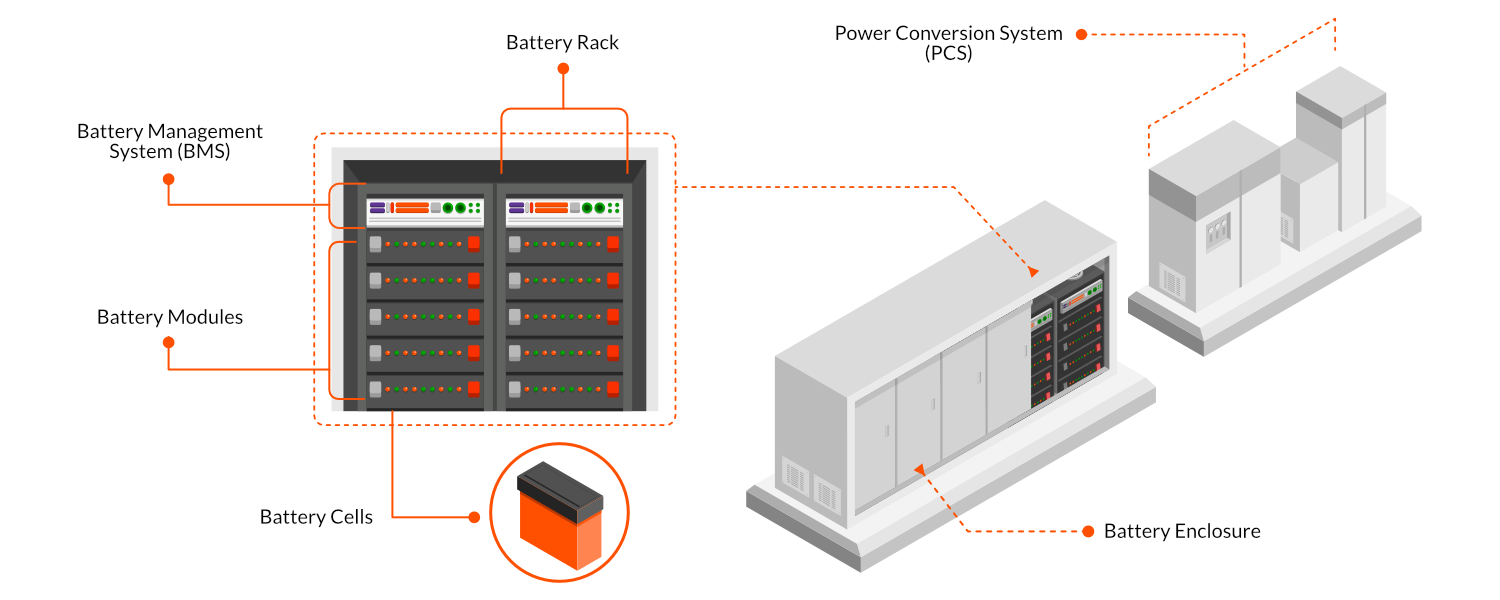
Basic Components of a Battery Energy Storage System
A typical battery energy storage system consists of several key components that work together to store and distribute electrical energy.
Battery Pack: This is the heart of the system, responsible for storing electrical energy in chemical form. Common types include lithium-ion batteries (such as lithium iron phosphate batteries and ternary lithium batteries), which are popular for their high energy density and long cycle life.
Power Storage Converter (PCS): This is a key component that acts as a bridge between the battery pack and the grid or load. During charging, it converts alternating current (AC) to direct current (DC), and vice versa during discharging.
Battery Management System (BMS): This can be considered the "brains" of the battery energy storage system. It monitors vital battery parameters such as voltage, current, temperature, state of charge (SOC), and state of health (SOH). It prevents overcharging, over-discharging, and overheating, thereby ensuring battery pack safety and extending its service life.
Control system: This system is responsible for overall coordination and management. It receives signals from the grid, renewable energy sources, or user demand and adjusts charging and discharging strategies accordingly.
Auxiliary equipment: This includes the cooling system, circuit breaker, and enclosure. The cooling system maintains the battery's optimal operating temperature, while the circuit breaker provides protection against electrical faults.
2. Workflow
The operation of a battery energy storage system can be divided into two main phases: charging and discharging. The specific process is as follows:
1. Charging Phase (Energy Storage)
Energy Source: This can come from cheap electricity during off-peak hours, excess generation from renewable energy sources (photovoltaic, wind power), or other distributed power sources.
Conversion Process:
If the source is AC (such as the grid or wind power), the PCS converts the AC power to DC.
If the source is DC (such as photovoltaic), it can be directly controlled by the BMS and then fed into the battery pack (or simply processed by the PCS).
Storage Process: DC power is converted into chemical energy through chemical reactions within the battery (such as the insertion and deintercalation of lithium ions) and stored. The BMS monitors and adjusts the charging current and voltage in real time to ensure balanced charging of all cells in the battery pack.
2. Discharging Phase (Energy Release)
Trigger Condition: When the grid is experiencing peak demand (high electricity prices), there is a power shortage, or renewable energy generation is insufficient, the system initiates discharge based on control system instructions. Conversion Process:
The battery pack releases DC power, which is regulated by the BMS and then transmitted to the PCS.
The PCS converts the DC power into AC power with the same frequency and phase as the grid, which is then fed into the grid to supplement power or directly supplied to local loads (such as factories and residences).
Grid connection requirements: The AC power during discharge must meet grid voltage, frequency, and harmonic standards, and is precisely controlled by the PCS to avoid impacting the grid.
3. Core Logic: Dynamic Control
The control system dynamically adjusts the charge and discharge strategy by collecting real-time data such as grid frequency, voltage, load demand, and electricity price signals. Examples include:
Peak-valley arbitrage: Charging during off-peak hours (low electricity prices) and discharging during peak hours (high electricity prices) to profit from the price difference;
Frequency and peak shaving: When the grid frequency fluctuates, rapid charging and discharging (millisecond response) is used to stabilize the frequency; when the load is excessive, discharging is used to reduce grid pressure.
3. Operating Characteristics of Different Application Scenarios
Grid-level energy storage: Large capacity (megawatts and above), focusing on rapid response (such as frequency regulation) and long-term discharge (such as peak shaving), requiring high PCS power density and BMS balance.
User-side energy storage: Smaller capacity (kilowatts to hundreds of kilowatts), primarily used for peak-valley arbitrage and emergency backup, with charging and discharging strategies more dependent on electricity prices and user usage habits.
Renewable energy storage: Requires rapid absorption of fluctuating photovoltaic/wind power output, prioritizing surplus renewable energy during charging and compensating for insufficient renewable energy generation during discharge, thereby reducing wind and solar curtailment.
4. Key Technical Challenges
Battery performance: Improving energy density (increasing storage capacity), cycle life (reducing replacement frequency), and safety (reducing fire risk) are key areas of focus.
PCS efficiency: Currently, the conversion efficiency of mainstream PCS is approximately 90%-96%. Improving efficiency can reduce energy loss.
Coordinated control: Large-scale energy storage systems require deep collaboration with the grid dispatching system to achieve precise and rapid response and avoid impacting grid stability.
In short, battery energy storage systems achieve the spatiotemporal transfer of electrical energy through the "electrical energy - chemical energy - electrical energy" conversion cycle, combined with intelligent control technology. They are one of the key technologies for resolving the contradiction between energy supply and demand and promoting the development of clean energy.