


An EMS is the "brain" of an energy storage system, ensuring safety, efficiency, and profitability. Without an EMS, energy storage units are merely passive energy storage devices. With an EMS, they become dynamic, flexible assets that enhance grid stability and improve customer economics.
What is an EMS in energy storage?
An energy management system is a software-driven control platform that monitors the performance of an energy storage system. It collects real-time data from batteries, inverters, renewable energy sources, and the grid, then uses algorithms to determine when and how to store, release, or conserve energy.
Batteries and inverters provide the physical infrastructure, while the energy management system (EMS) provides the intelligence. Essentially, it transforms the hardware into an intelligent, responsive, and optimized solution.
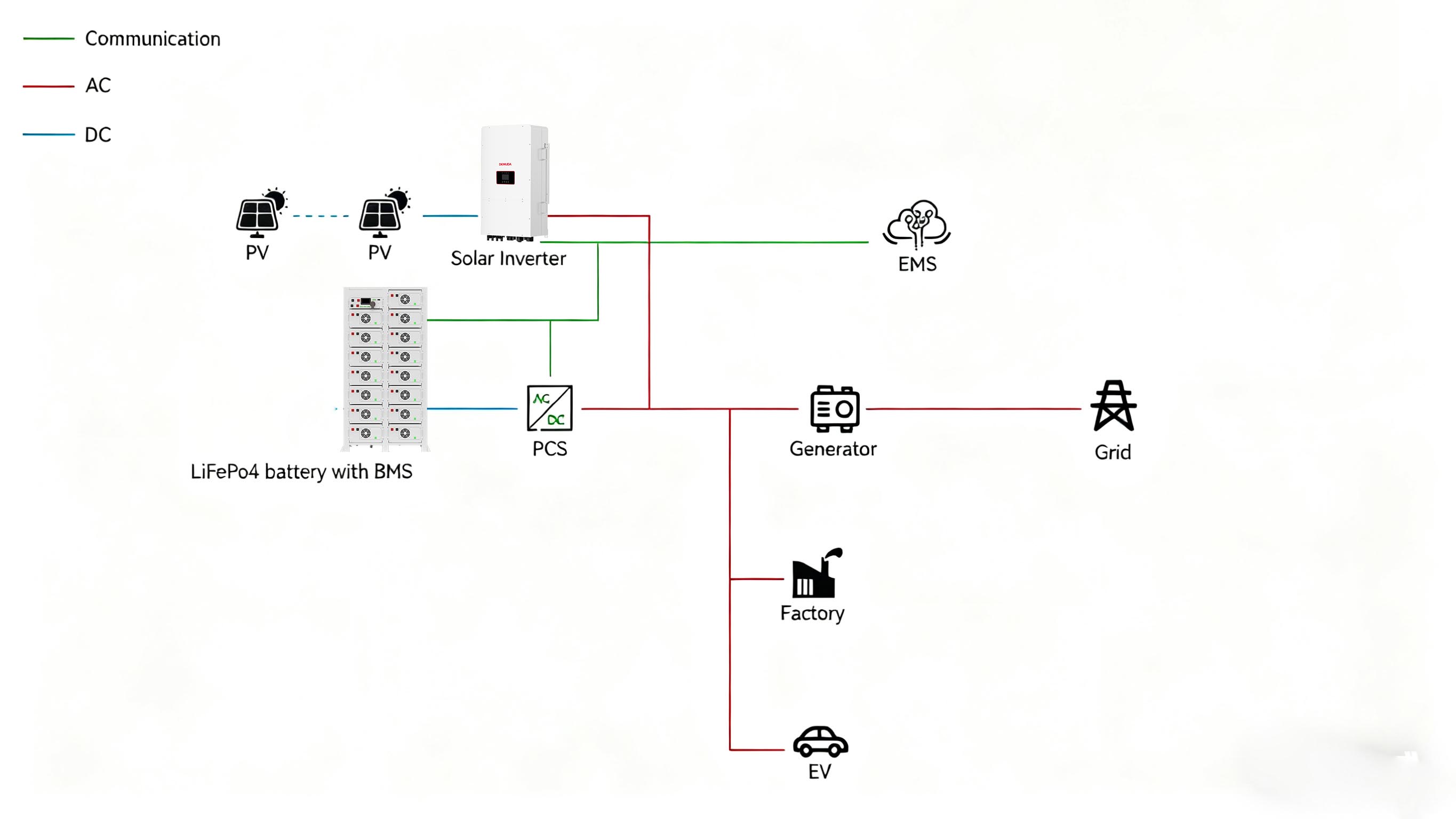
Core Functions of an EMS
1. Monitoring and Data Collection
✅ An EMS continuously monitors the following key parameters:
✅ Battery State of Charge (SOC) and State of Health (SOH).
✅ Voltage, current, and power flow.
✅ Renewable energy generation forecasting.
✅ Grid signals, such as frequency, demand, and price fluctuations.
This data foundation enables the EMS to make informed decisions in real time.
2. Optimization and Control
An EMS ensures that energy is used in the most efficient manner. Typical strategies include:
✅ Peak shaving: Discharging during peak demand to reduce electricity costs.
✅ Load shifting: Charging when prices are low and discharging later.
✅ Backup power: Prioritizing critical loads during outages.
✅ Frequency regulation: Rapid response to stabilize grid operations.
3. Safety and Protection
EMS works in conjunction with the battery management system (BMS) to prevent batteries from overcharging, deep discharging, or overheating. It also provides protection against grid failures and cybersecurity risks.
4. Forecasting and Dispatch
By analyzing weather data, market signals, and usage patterns, EMS can predict future energy demand and renewable energy generation, enabling proactive dispatch rather than reactive operation.
5. Market and Grid Integration
Advanced EMS platforms connect energy storage systems to the broader energy market, enabling them to participate in demand response programs, ancillary services, and even virtual power plants.
EMS Applications in Energy Storage
Residential Systems
For residential customers with rooftop solar, an EMS can maximize their own electricity consumption, reduce electricity costs under time-of-use rates, and ensure backup power during power outages.
Commercial and Industrial (C&I)
Businesses use energy management systems (EMS) to reduce peak demand charges, stabilize power quality, and ensure a reliable energy supply for operations such as manufacturing and data centers.
Utility-Scale Projects
Large-scale grid-connected energy storage facilities rely on EMS to integrate variable renewable energy sources, provide frequency and voltage regulation, and participate in wholesale electricity markets.
Microgrids and Remote Areas
In remote or disaster-prone areas, EMS can balance multiple energy sources—solar, diesel, wind, and batteries—to ensure an autonomous and resilient power supply.