


1. Structural Differences Between Off-Grid and Hybrid Solar Systems
1.1 Off-Grid System
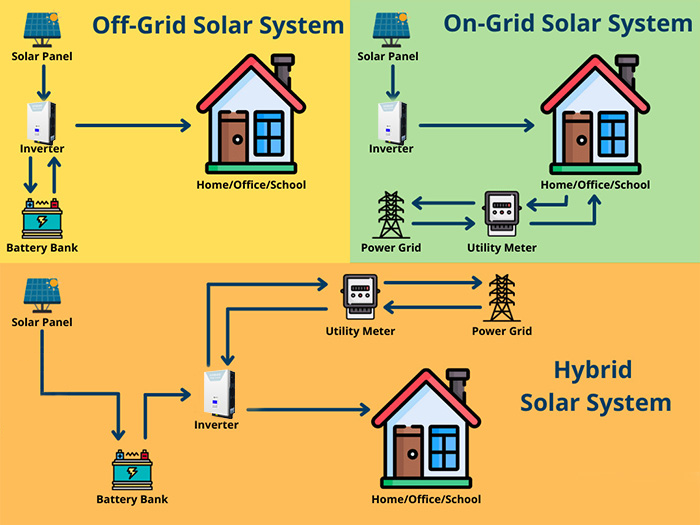
Off-grid systems operate completely independently of the public power grid. Solar modules charge the batteries, and the inverter converts the DC power from the batteries into AC power for powering loads. Such systems typically include:
• Solar panels
• Solar Combiner Box
• Charge Controller (MPPT or PWM)
• Energy Storage Batteries (mostly lithium-ion or gel batteries)
• Off-Grid Inverter
Application Scenarios: Remote rural areas, emergency backup power, island power supply, RV systems, campsite power supply, etc.
Core Requirements: Inverters must have high starting current capability; batteries must have long cycle life and high discharge rate capability.
1.2 Hybrid Solar System
Hybrid systems possess both off-grid and grid-tied capabilities, enabling intelligent switching between "solar energy - battery - grid". Their core component is the Hybrid Inverter (also known as PV Hybrid Inverter), which integrates internally:
• MPPT Controller
• Inverter Module
• Mains Charging Module
• Automatic Switching (UPS) Module
During daytime, it prioritizes the use of photovoltaic power. When the batteries are fully charged, the excess power is fed into the grid; in the event of a grid outage, it can instantly switch to battery power supply.
Application Scenarios: Areas with high electricity prices, countries with weak power grids, small and medium-sized commercial loads requiring UPS, BESS residential energy storage systems.
Core Advantages: Higher system flexibility, better energy management capabilities, and in-depth integration with lithium-ion batteries.
2. Inverter System Structure and Performance Key Points
The inverter is the core of the system, and its performance directly determines the stability of the entire system.
2.1 Importance of Pure Sine Wave Inverters
High-quality Pure Sine Wave Inverters can provide clean waveforms similar to mains power, ensuring:
• Stable operation of inductive loads (refrigerators, air conditioners)
• No noise or damage to electronic products
• High compatibility with grid-tied power equipment
Common capacities include 1000W, 3000W, 5000W, 8000W, etc. In engineering applications, attention should be paid to the starting current multiple, peak power capability, and efficiency curve.
2.2 Structural Differences Between Off-Grid Inverters and Hybrid Inverters
Item | Off-Grid Inverter | Hybrid Inverter |
Grid-Tied Capability | No | Yes |
Built-in MPPT | No (requires independent controller) | Yes |
Power Supply Reliability | Medium | High (UPS Mode) |
System Cost | Lower | Higher |
Battery Compatibility | 12V/24V/48V | Mainly 48V, supports lithium-ion battery protocols |
Hybrid inverters are more suitable for matching with 48V Lithium-Ion or LiFePO₄ batteries, and can achieve optimal charging and discharging strategies through BMS protocols.
3. Energy Storage Battery Types and Technical Key Points
In solar systems, batteries not only affect energy storage capacity but also directly impact system lifespan, discharge rate, safety, and cost.
3.1 Gel Battery
Gel batteries are deep-cycle lead-acid batteries, suitable for off-grid systems with limited budgets.
Advantages:
• Low cost
• Simple maintenance
• Strong over-discharge resistance
Disadvantages:
• Short cycle life (500–800 cycles)
• Low energy density
• Heavy weight and low efficiency
3.2 Lithium-Ion Battery
Common types include NCM, NCA, etc. They have high energy density, making them suitable for installation environments with limited space.
Precautions:
• Requires matching BMS (Battery Management System)
• Sensitive to over-charging and over-discharging
• Requires high-quality chargers or Hybrid Inverters for management
3.3 LiFePO₄ (Lithium Iron Phosphate) Battery
This is the mainstream choice for current residential energy storage, outdoor power supplies, and BESS systems.
Core Advantages:
• Long cycle life (3000–6000 cycles)
• Extremely high thermal stability
• Wide operating temperature range
• Higher safety than NCM/NCA
Common Specifications: 12V 200Ah, 24V systems, 48V 100Ah–200Ah, etc. They are widely used in 5kWh, 8kWh, 10kWh, 15kWh, and 25kWh energy storage systems.
4. Solar Charge Controller and MPPT Technology
The charge controller is a key device connecting solar panels and batteries, mainly divided into two types:
4.1 PWM Controller
It has a simple structure and low cost, but its efficiency is 70–80%, making it suitable for low-power systems.
4.2 MPPT Controller
By tracking the Maximum Power Point, it increases power generation efficiency by 20–30%.
Key factors to consider when selecting an MPPT controller:
• Maximum allowable Voc (Open Circuit Voltage) input
• Maximum PV power
• Operating voltage (12V/24V/48V automatic identification)
• Support for lithium-ion battery charging curves
• Heat dissipation structure and protection mechanisms
The built-in MPPT of Hybrid Inverters can now replace independent controllers.
5. Solar Combiner Box Functions and Design Key Points
In medium and large-scale solar systems, before multiple PV outputs reach the inverter, they need to pass through the combiner box for the following processes:
• Circuit combining
• Overcurrent protection (fuse or DC circuit breaker)
• Lightning protection
• Isolation switch
A reasonable combining design can reduce system voltage fluctuations, improve overall safety, and facilitate maintenance.
Large-scale systems are often equipped with DC circuit breakers, SPD (Surge Protective Device), isolation switches, and real-time monitoring modules.
6. Solar System Wiring Methods: Series-Parallel Connection and Complete Wiring Diagram
6.1 Solar Panel Series Connection
Characteristics:
• Voltage superposition
• Current remains unchanged
• Suitable for long-distance transmission and systems with high-voltage input for MPPT
Applicable to: 600V / 1000V / 1500V commercial systems.
6.2 Solar Panel Parallel Connection
Characteristics:
• Voltage remains unchanged
• Current superposition
• Classified series-parallel connection can balance component shading or aging differences
Applicable to: Low-voltage, short-distance wiring, and small-scale systems.
6.3 Battery Series and Parallel Connection
(1) Series Connection
• Voltage superposition: Two 12V batteries connected in series provide 24V
• Current remains unchanged
• Suitable for higher system voltages (can reduce line loss)
(2) Parallel Connection
• Voltage remains unchanged
• Capacity superposition
• Requires consistent battery internal resistance and production batches
In engineering practice, it is often necessary to:
• Connect two groups of 12V 200Ah batteries in series to form a 24V system
• Connect multiple groups of 48V LiFePO₄ batteries in parallel to form 5kWh, 10kWh, 15kWh, and 25kWh modular systems
6.4 Key Points of System Wiring Diagram
A standard off-grid or hybrid system typically includes the following wiring key points:
• PV → Combiner Box → MPPT / Hybrid Inverter
• Battery → Inverter DC Input (ensure correct polarity and cable cross-sectional area)
• AC Output → Distribution Box → Load
• Unified grounding system (Earth/PE)
• Independent circuits for high-power loads
Engineers should pay special attention to:
• DC side cable selection
• AC side branch protection
• Capacity matching of DC fuses and circuit breakers
• Reverse connection protection
• Layout of grounding copper bars
• Cascading design of lightning protection devices
7. System Selection Recommendations: How to Choose Configurations for Different Scenarios
7.1 Residential Systems (3kW–10kW)
Recommended Configuration:
• 5kW–10kW Hybrid Inverter
• 48V LiFePO₄ Battery (5–15kWh)
• 4–12 solar panels of 400W+
• Level 2 AC Protection
Applicable to: Residences, stores, and areas with weak power grids.
7.2 Small Commercial/Office Systems (10kW–50kW)
Recommended Configuration:
• Three-Phase Hybrid or High-Power Off-Grid Inverter
• 15–50kWh Modular Energy Storage System
• Multi-channel MPPT, Combiner Box with Monitoring Function
• 10kVA–50kVA Industrial Frequency Transformer (if required by loads)
7.3 Industrial / Long-Term Off-Grid Systems in Remote Areas
Recommended Configuration:
• High-Power Off-Grid Inverter (20kW Class)
• Battery System of 25kWh and Above
• Industrial-Grade MPPT
• Solar Array Design with High-Voltage Series Connection
Priority considerations: Safety, backup capability, and scalability.
8. Conclusion: The Core of High-Quality System Design Lies in Overall Optimization
Whether choosing an off-grid or hybrid architecture, a highly reliable solar energy storage system must achieve a balance in the following aspects:
• Reasonable inverter selection (performance, efficiency, compatibility)
• Stable and safe energy storage system (LiFePO₄ is preferred)
• Efficient MPPT controller and complete protection system
• Standardized wiring diagram and safe wiring design
• System capacity configured according to requirements
From electrical safety to system efficiency, and from component selection to actual wiring, every link directly affects the final performance of the system. Only through sufficient planning during the design phase can a safe, long-life solar energy storage system suitable for various application scenarios be constructed.