


1. Why should we choose a solar charge controller?
Solar charge controller (also commonly called regulator) is an indispensable core component in solar power generation system. In solar photovoltaic system, "solar panel → battery → load" constitutes the basic chain. The output of solar panel is affected by factors such as light intensity and temperature, and the voltage and current fluctuate greatly. If there is a lack of voltage and current regulating components, the battery may be damaged or even cause safety hazards due to overcharging, undercharging or failure to charge efficiently. Its main function is to intelligently manage the charging process of solar panels to batteries to ensure efficient, safe and stable operation of the system.
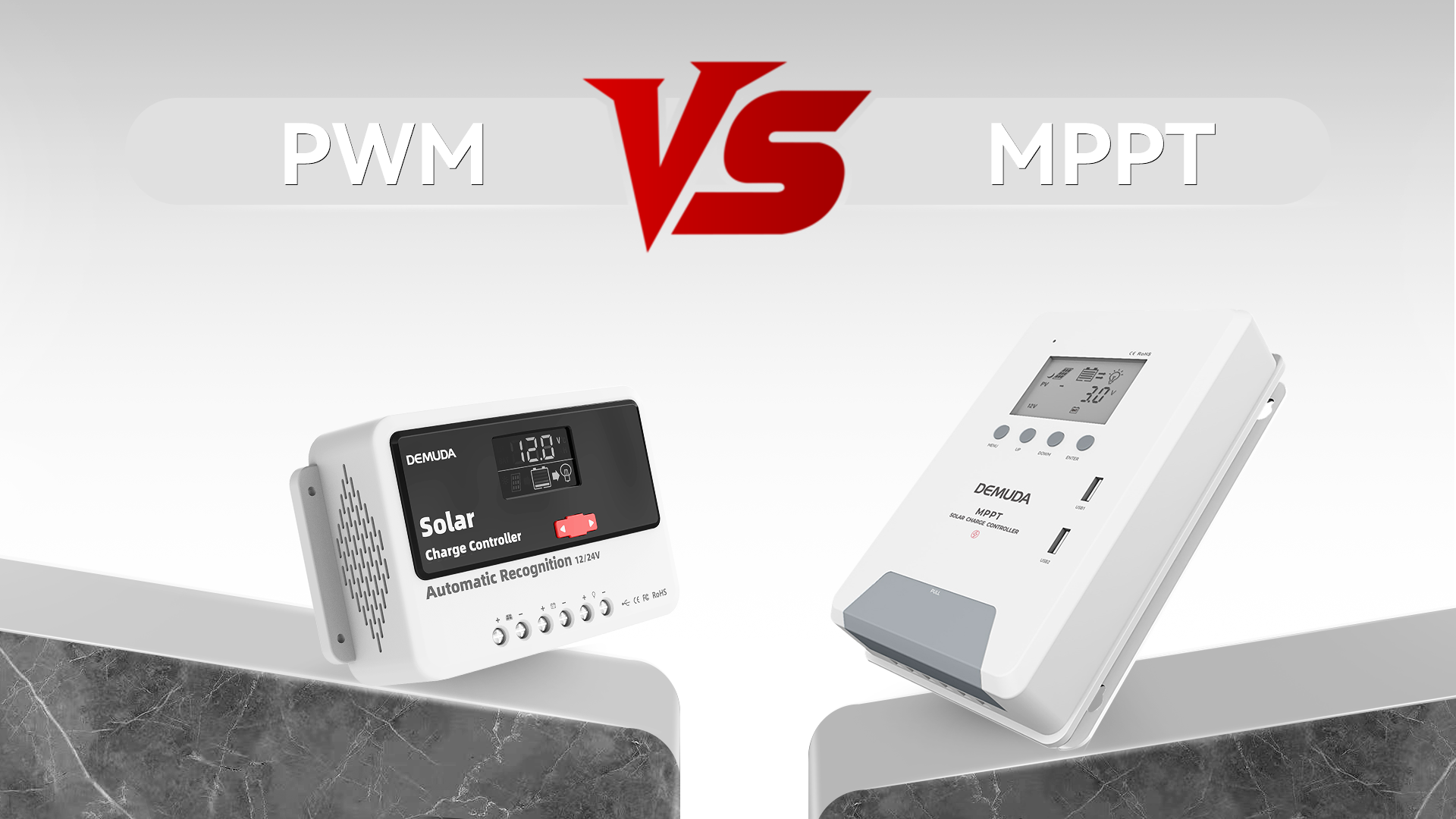
PWM (Pulse Width Modulation) and MPPT (Maximum Power Point Tracking) are the two mainstream charge controllers in 2025. Many users will be entangled when choosing. The following is a detailed analysis from the aspects of working principle, key performance, applicable scenarios, etc. to help you make a suitable choice.
2. Working Principles of PWM and MPPT
PWM (Pulse Width Modulation) solar charge controller is an economical and practical solar charge management device. Its core principle is to control the charging current through fast switching, so that the output voltage of the solar panel matches the battery voltage and prevent overcharging. Its working process can be divided into the following stages: direct charging stage → constant voltage stage → floating charging stage.
MPPT (Maximum Power Point Tracking) solar charge controller is a high-efficiency intelligent charging management device. Its core principle is to dynamically adjust the working point of the solar panel so that it always outputs the maximum power, thereby significantly improving the energy conversion efficiency. Its charging stage is similar to PWM: constant current fast charging → constant voltage absorption → floating charging.
3.Key performance comparison
Efficiency
PWM: Theoretical efficiency is 70% - 80%, but may be lower in practice. Voltage matching and environmental changes (light, temperature) have a great impact on it. When the light is unstable, the solar panel voltage is difficult to match the battery voltage, and the efficiency drops significantly. For example, on cloudy days, the output voltage of the solar panel is low and deviates from the battery voltage, and the charging efficiency may drop below 50%.
MPPT: The conversion efficiency exceeds 95%, and it has significant advantages in environments with variable light and temperature. In cold environments (high voltage of solar panels) and weak light in the early morning/evening (large voltage fluctuations), MPPT can accurately track the maximum power point and maintain efficient charging. In winter in the north, the photovoltaic system uses an MPPT controller, and the power generation is 20% - 30% higher than PWM.
Cost
PWM: The structure and control algorithm are simple, the hardware requirements are low, and the purchase cost is low, which is suitable for small projects with limited budgets. No complex circuits and high-precision chips are required during production, and the cost may be only 1/3 - 1/2 of the MPPT controller.
MPPT: It requires complex circuits (such as DC-DC converters), high-precision ADCs (analog-digital converters), and high-performance MCUs (microcontroller units) to implement algorithms. The purchase cost is high, generally several times that of PWM controllers. However, in the long run, it can generate more electricity and reduce the cost per kilowatt-hour. In large-scale systems, the cost can be recovered through high power generation.
Input voltage tolerance
PWM: The maximum power point voltage (Vmpp) of the solar panel is required to be close to the battery pack voltage (error ±10%~20%). For example: 12V battery system → recommended solar panel Vmpp ≈ 15~18V (such as 18V panel); 24V battery system → recommended Vmpp ≈ 30~36V (such as 36V panel). The upper limit of the open circuit voltage (Voc) that the PWM controller can usually withstand is ≤ 1.5~2 times the battery voltage (such as 12V battery system, Voc ≤ 25V).
MPPT: The minimum operating voltage needs to be slightly higher than the battery charging voltage (such as a 12V battery system, the input must be ≥ 15V to start, the maximum input voltage of ordinary MPPT: Voc ≤ 100~150V (such as a 12V/24V system), the maximum input voltage of high-voltage MPPT: Voc ≤ 250~600V (for high-power off-grid systems).
MPPT can automatically adjust the input voltage to the optimal power point (such as a 60V solar panel charging a 12V battery), and efficiently reduce the voltage through DC-DC conversion.
System expansion
PWM: Supports parallel expansion of solar panels. Due to the low input voltage tolerance of PWM, solar panels cannot increase the system voltage by series connection. High-power systems require multiple PWM controllers in parallel, which increases complexity. Only supports parallel connection of battery packs with the same voltage. If the original system is a 12V battery, the expansion can only be paralleled with 12V New battery (capacity increased, voltage unchanged), battery series connection prohibited.
MPPT: Solar panels can be flexibly expanded, and solar panels can be directly connected in series to MPPT. The controller automatically reduces the voltage to the battery voltage, and the efficiency remains 90%+, which can reduce line losses. It is suitable for large-scale power stations and also supports battery series/parallel connection.
Comparison Dimension | PWM | MPPT |
Efficiency | Generally 70 - 80%. Can be close to MPPT when the sunlight condition is good and the voltage is close to the battery voltage | Can reach 95 - 99%. Efficiency increases by 25 - 40% on cloudy days |
Cost | 20 - 60 USD | 80 - 500 USD, with 100 - 300 USD as the mainstream |
Input Voltage Tolerance | Must be consistent with the battery voltage | Can accept input voltage much higher than the battery voltage, even several times higher |
System Scalability | Series connection is not allowed, only suitable for parallel operation | Flexibly supports series - parallel combination, convenient for capacity expansion |
Temperature/Shading Environment | Performs well on hot days, but has poor tolerance to short - term shading | Shows significant improvement under temperature differences and shading, with a wide adaptation range |
Complexity and Reliability | Simple structure, easy to maintain | Complex structure, requiring elaborate debugging and monitoring |
Volume and Weight | Small and lightweight | Slightly larger and heavier (including DC - DC conversion circuit) |
4.Applicable scenarios
(I) PWM applicable scenarios
1️⃣Small off-grid equipment: small lighting systems for outdoor camping, portable solar charging packs (charging mobile phones and small appliances), low power (within tens of watts), easy matching of solar panels and battery voltages (such as 5V/12V systems), low cost of PWM, and can meet basic charging needs.
2️⃣Strict budget and stable light: Simple photovoltaic pumping systems in some remote areas, with limited budgets, long local light duration and stable intensity(such as areas with sufficient and stable light on the edge of the desert), matching solar panels and battery voltages (12V panels charging 12V batteries), PWM can work stably, although the efficiency is not as good as MPPT, but it can control costs.
3️⃣Simple systems with strict voltage matching: Small household photovoltaic systems, users clearly know the voltages of solar panels and batteries (such as 24V panels with 24V batteries), and do not pursue extreme power generation efficiency. PWM controllers are easy to install and low cost, making them an economical choice.
(II) MPPT applicable scenarios
1️⃣Medium and large photovoltaic systems: household energy storage systems (several kW to tens of kW), which need to store solar power generated during the day for use at night or on cloudy days; commercial/industrial photovoltaic power stations (tens of kW or more), which pursue high power generation and return on investment. MPPT can improve overall efficiency, and the benefits of more power generation are far higher than its cost.
2️⃣Areas with large light/temperature differences: high-altitude areas (strong light but large temperature changes, the temperature difference between morning and evening may exceed 20℃), cold areas (low temperatures in winter increase the voltage of solar panels), and areas with cloudy weather (frequent light fluctuations). MPPT dynamically tracks the maximum power point, adapts to complex environments, and ensures power generation efficiency.
3️⃣Scenario of high-voltage panels charging low-voltage batteries: There are many solar panels connected in series, and the voltage is high (such as 36V, 48V), but the battery is low voltage (12V, 24V), such as RV photovoltaic systems (limited space, using high-voltage panels to reduce wiring and losses), MPPT can efficiently convert the power of high-voltage panels to low-voltage batteries to avoid energy waste, while PWM cannot handle this voltage mismatch and will greatly reduce efficiency.
5. Summary
Small, limited budget, stable environment → PWM;
Medium system, complex environment or unstable voltage → MPPT;
Large, high voltage, need to expand or intelligent → MPPT is a must.
The selection of solar charging controller should be based on actual needs, system scale, environmental conditions and budget. Choosing the right controller can make the photovoltaic system more stable and efficient, maximize its value, and help the use of green energy.