


That is the short version. Below is how the decision actually works in practice.
The voltage class refers to the DC bus voltage between the battery and the inverter.
· Low voltage (LV) systems use a 48 V nominal battery bank. With LiFePO4 cells, the standard configuration is 16 cells in series (16S), giving a nominal 51.2 V. LV hybrid inverters typically cover 3 kW to 12 kW and work with single-phase or small three-phase grids.
· High voltage (HV) systems stack battery modules in series until the battery string reaches a window commonly between 160 V and 700 V. HV hybrid inverters typically start around 6–10 kW and extend to 60 kW or more for commercial use.
For example, DEMUDA's low voltage hybrid line covers 6–12 kW single-phase and three-phase models, while its high voltage three-phase hybrid inverter (DF-HVHH series, 8–60 kW) accepts batteries in the 160–700 V window with charge and discharge currents up to 50 A — a combination aimed at large residential and commercial projects.
Factor | Low Voltage (48 V / 51.2 V) | High Voltage (160–700 V) |
Typical inverter size | 3–12 kW | 8–60 kW |
Battery configuration | 16S LiFePO4 (51.2 V), parallel strings | Series-stacked HV modules |
DC current at the same power | High (I = P / V) | Low |
Cable size for the same power | Thicker | Thinner, cheaper, easier routing |
Efficiency under heavy load | Good | Slightly better at high power (lower I²R losses) |
Installation complexity | Simple; familiar to most installers | Requires series wiring discipline and HV safety practice |
Scalability | Add parallel strings | Add modules/parallel inverters (e.g., up to 10 units in parallel) |
Typical cost structure | Lower entry cost | Higher entry cost, better cost-per-kW at scale |
Best fit | Small homes, retrofits, off-grid cabins, 48 V ecosystems | Large homes, three-phase villas, C&I sites, future expansion |
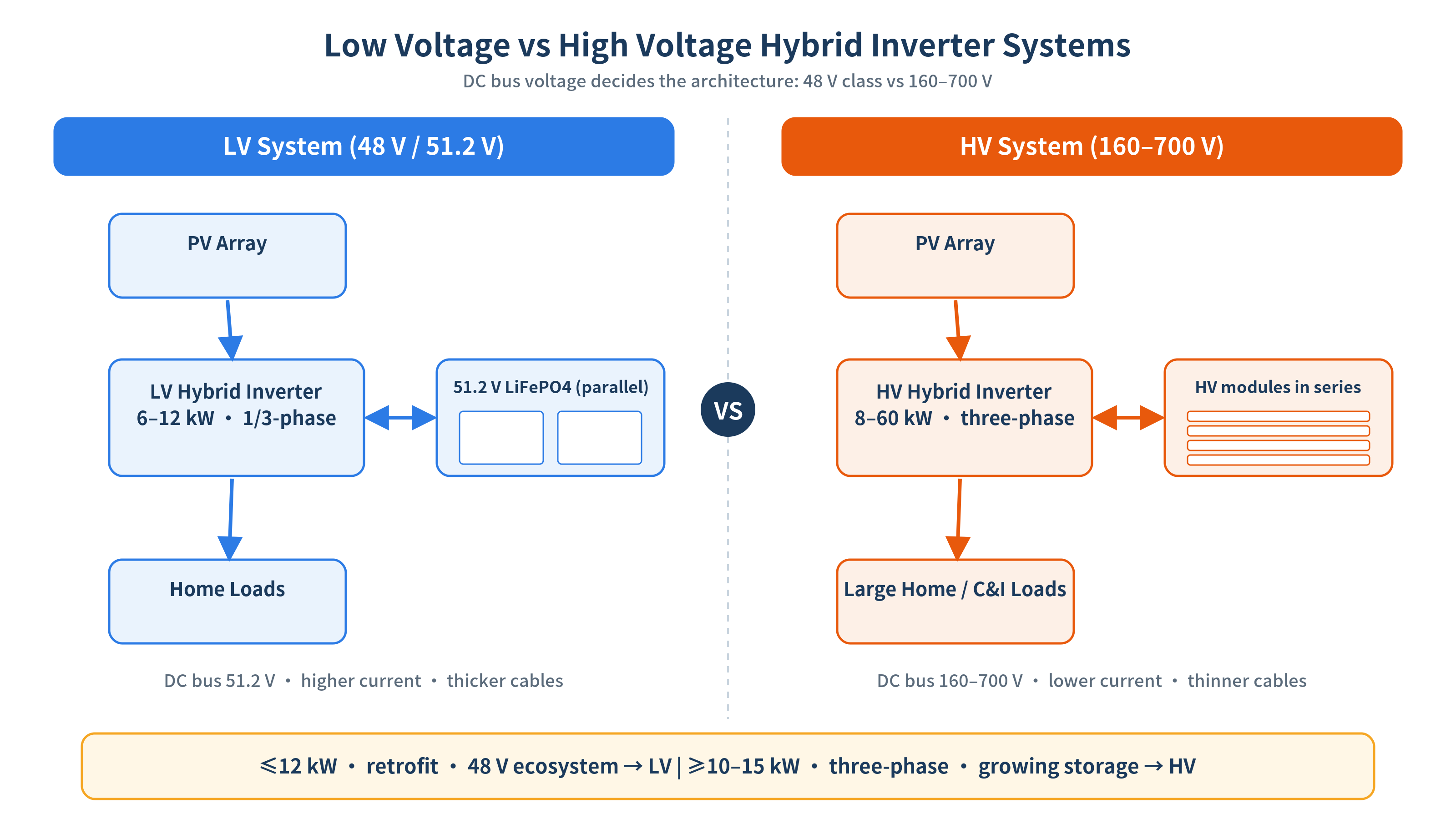
Figure 1 · LV vs HV hybrid inverter system architectures: DC bus voltage decides cables, efficiency and scalability
1. Retrofits and replacements. If a site already runs 48 V lead-acid or lithium banks, an LV hybrid inverter often reuses the existing wiring and protection hardware with minimal redesign.
2. Small residential projects. For a household load of roughly 5–12 kW, a 6–12 kW LV single-phase hybrid inverter matched to one or two 51.2 V LiFePO4 packs (for example 5 kWh rack-mounted modules or 15–30 kWh floor-standing units) covers most backup plus self-consumption needs.
3. Simpler safety handling. 48 V-class DC is far below the thresholds that require special HV work practices, which shortens installer training time — an advantage in markets where installer networks are still developing.
4. Battery flexibility. LV inverters commonly accept a wide range of 48 V batteries, including lead-acid, gel and multiple LiFePO4 brands, which helps distributors keep stock simple.
1. Lower current, lower losses. Power equals voltage times current. Delivering 10 kW at 51.2 V requires about 195 A; delivering the same 10 kW at 400 V requires only 25 A. Lower current means thinner DC cables, smaller breakers, and less heat (I²R losses scale with the square of the current). Above roughly 10 kW this becomes a real material and efficiency advantage.
2. Better fit for three-phase and commercial loads. HV three-phase hybrid inverters in the 8–60 kW range serve large villas, workshops, farms and small commercial sites. DEMUDA's HV three-phase hybrid series reaches 97.6% maximum efficiency (97.0% Euro efficiency, 99.9% MPPT efficiency), supports up to 10 units in parallel for off-grid operation, and accepts diesel generator input directly — no external converter required.
3. Cleaner expansion path. HV battery racks scale by adding modules in series or parallel strings within the inverter's voltage window (160–700 V in the DEMUDA HV series). Planning storage growth from 20 kWh to 100 kWh+ is structurally easier than with 48 V parallel banks.
4. Long cable runs. Where the battery room sits far from the inverter, HV wiring keeps voltage drop and cable cost under control.
1. Total inverter power ≤ 12 kW, single-phase grid, retrofit or tight budget → LV system.
2. Three-phase load, inverter power ≥ 10–15 kW, or expected storage growth beyond 30 kWh → HV system.
3. Off-grid or weak-grid with a diesel generator → prefer an HV hybrid inverter with native generator input and strong off-grid peak capability (e.g., 1.5× rated power for 10 seconds), so motor starts and pump surges do not trip the system.
4. Standardize on one ecosystem per project. Mixing LV batteries with an HV inverter (or vice versa) is not possible — voltage architecture is fixed by design, so decide once at the quoting stage.
· Low voltage line: 6 kW / 8 kW / 10 kW / 12 kW single-phase hybrid inverters, plus 6–12 kW low voltage three-phase models, paired with 51.2 V LiFePO4 batteries (5 kWh rack-mounted, 15 / 20 / 30 kWh Grade-A-cell units).
· High voltage line: 8–60 kW three-phase hybrid inverters (160–700 V battery window, up to 50 A charge/discharge, IP65, WiFi/App monitoring, 5-year warranty with a 10-year option), paired with high voltage rack-mounted batteries from 5 kWh up to 143–215 kWh cabinets for commercial sites.
· One supplier, both architectures simplifies distributor stock and lets EPCs quote the same brand across residential and C&I tenders.
Q: Can I use a 48 V battery with a high voltage hybrid inverter?
A: No. HV hybrid inverters require a battery string inside their voltage window (for example 160–700 V). A single 51.2 V battery is far below that window and cannot be recognized or charged safely. Choose batteries that match the inverter's voltage class.
Q: Are high voltage systems more dangerous?
A: HV DC requires proper installation practice — correct series wiring, rated connectors, DC isolation and trained installers. With compliant installation (IEC/EN 62109 series safety standards, IP65 enclosures), HV systems are widely deployed in homes and commercial sites without incident.
Q: Which architecture has better efficiency?
A: Both classes reach similar headline efficiencies at their rated points; the practical difference shows at high power. HV systems carry lower current, so cable and conversion losses at 10 kW+ are typically lower. DEMUDA's HV three-phase hybrid series is rated at up to 97.6% maximum efficiency.
Q: What is better for future expansion, LV or HV?
A: HV scales more cleanly for large capacities: you add modules within the voltage window or parallel multiple inverters. LV banks grow by paralleling strings, which is fine for modest growth but becomes cumbersome above tens of kWh.
Q: For a 10 kW home system, should I choose LV or HV?
A: Both work. If the home is single-phase and cost-sensitive, a 10 kW LV hybrid inverter with 51.2 V LiFePO4 storage is the common choice. If the home is three-phase or plans to expand storage beyond ~30 kWh, an HV system is the better long-term fit.