


Quick answer: Chinese manufacturers supply roughly 80% of the world's solar inverters (per 2025 shipment data cited by industry trackers GEP and Wood Mackenzie), and most private-label inverter brands you see in regional markets are built by OEM/ODM factories there. The right partner is verified in five areas: traceable certifications for your market, real R&D (especially BMS communication protocols), manufacturing and QC depth, commercial terms (MOQ, lead time, warranty), and a documented onboarding process. Below is the checklist we recommend distributors apply before placing a first order.
· OEM (Original Equipment Manufacturer): the factory builds your design to your specification — your topology choices, your firmware requirements, your brand. You own the product definition. Typical for mature distributors with engineering capacity.
· ODM (Original Design Manufacturer): the factory offers a proven, existing platform that you brand and configure (logo, color, app skin, regional grid parameters). Faster to market, lower risk, smaller MOQ. This is how most regional solar brands start.
Many factories advertise "OEM/ODM" but only do one well. Ask which products are truly customizable and which are white-label-only, and get the answer in writing.
1. Certifications that match your market — and trace.
Match the certificate to the regulation: CE/LVD/EMC and EN 50549 grid codes for the EU, UKCA for the UK, IEC 62109-1/-2 safety for inverters, IEC 62619 for lithium batteries, UN 38.3 for battery transport. Ask for certificate numbers and verify them with the issuing body — a factory that cannot produce verifiable certificates for its own flagship products is a hard stop.
2. Real R&D, not just assembly.
The differentiator in hybrid inverters is firmware: battery communication protocols (CAN/RS485 and the protocol library for major BMS brands), grid-tie logic, generator control, time-of-use scheduling. Ask: how many engineers work on firmware? Can you add a new battery brand protocol on request, and in what timeframe?
3. Manufacturing depth and QC.
Look for: factory area and line count, ISO 9001 quality system, incoming QC on cells (Grade-A cell sourcing with batch records), burn-in/aging test on finished inverters, and documented defect rates. A video tour is fine for the first screen; before a container order, visit or hire a third-party inspection.
4. Product range breadth.
A one-stop supplier — hybrid inverters from 3 kW residential to 60 kW commercial, low and high voltage LiFePO4 batteries, all-in-one residential storage and C&I cabinets — lets you grow a full catalog without qualifying a second factory, and keeps warranty responsibility in one place.
5. Warranty and after-sales model.
Standard inverter warranty in this segment is 5 years with a 10-year option; batteries typically 5 years. Clarify: who processes RMA in your market, what the spare-parts policy is, whether the monitoring platform runs under your brand, and whether remote diagnosis is available to your technicians.
6. Commercial terms.
Realistic expectations to benchmark against: MOQ often starts at one mixed container for branded orders; production lead time typically 15–30 days after technical confirmation; payment commonly 30% deposit + 70% before shipment for new partners. Extremely short quoted lead times and prices far below the market mean something is being cut — usually cells or capacitors.
7. Onboarding process.
Serious factories run a documented process: requirements gathering (load, scenario, budget, target market) → solution design with configuration list → technical confirmation of key parameters → manufacturing, inspection and delivery → after-sales. If each step has a stated duration, the factory manages projects; if nobody can describe the process, expect improvisation.
8. References in your region.
Ask which distributors already sell the factory's products in neighboring markets. Operating references outside your territory indicate experience without direct channel conflict.
· Certificates shown as pictures only, no numbers to verify
· No datasheet for the exact SKU you are quoting (specs "similar to" another model)
· No documented BMS protocol list for batteries
· Unwilling to allow third-party pre-shipment inspection
· Price significantly below every other quote — in power electronics, the gap is paid by component quality
DEMUDA (founded 2011) operates standardized production bases of 35,000 m² in Guangzhou and Foshan, with products certified for CE, RoHS, FCC, CB, ISO 9001, UKCA, C-Tick, LVD and PSE, and sold in more than 100 countries. The OEM/ODM onboarding follows five steps with committed durations:
Step | What happens | Typical duration |
1. Demand communication | Power requirements, application scenarios, budget | 1–3 days |
2. Solution design | System capacity calculation, architecture, configuration list | 1–2 days |
3. Technical confirmation | Key parameters and technical agreement finalized | 2–3 days |
4. Manufacturing & delivery | Production, quality inspection, logistics, installation guidance | 15–30 days |
5. After-sales support | Remote monitoring, 24/7 technical support, maintenance, upgrades | Long-term |
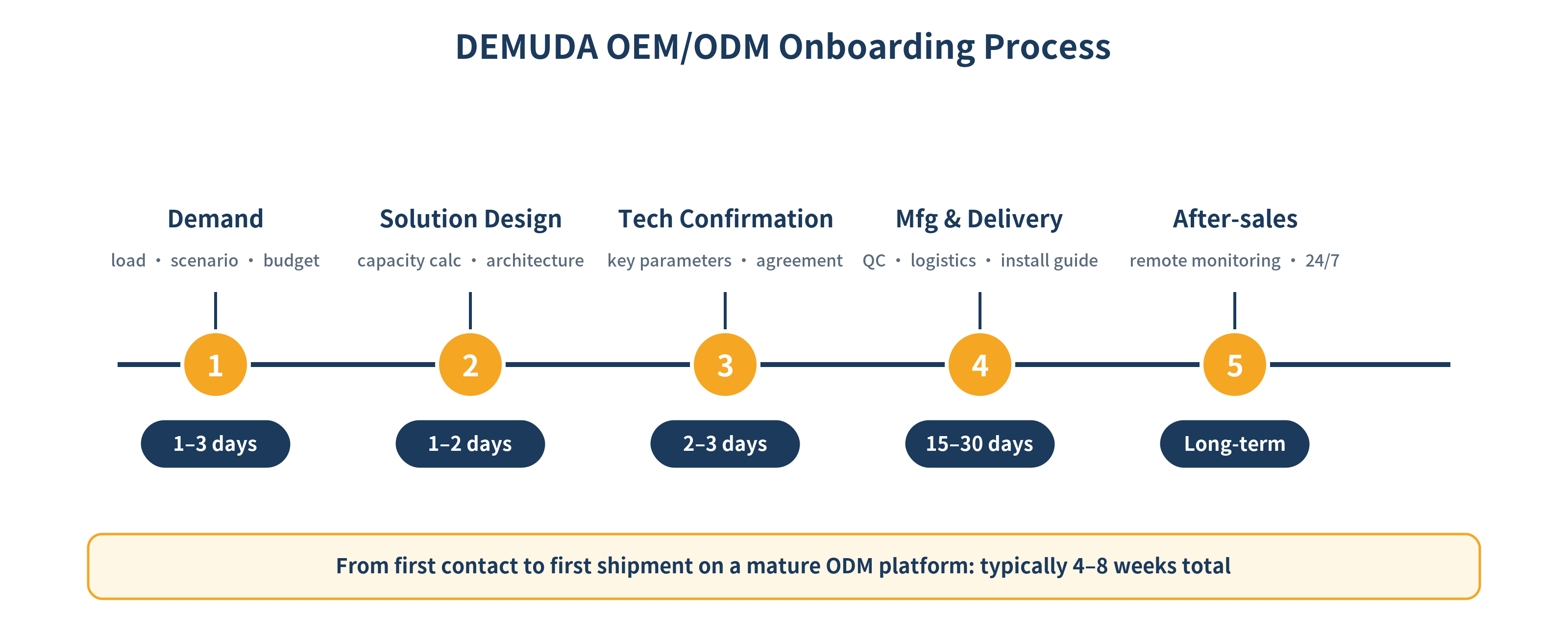
Figure 3 · DEMUDA OEM/ODM onboarding: five steps with committed durations
The catalog spans single and three-phase hybrid inverters (6–60 kW), low voltage and high voltage LiFePO4 batteries (5 kWh modules to 215 kWh racks), all-in-one residential ESS and C&I storage cabinets — all available under distributor branding. DEMUDA is actively recruiting global distributors and provides brand authorization, product supply, technical training and after-sales backing to partners.
Q: What MOQ should I expect from a Chinese inverter OEM?
A: For ODM (existing platform, your brand), many factories start at one mixed container or even a smaller trial order for promising distributors. For OEM designs with custom hardware, MOQs are higher because of tooling and component commitments. Always tie MOQ to a written first-year purchase plan.
Q: How long does private-labeling take from first contact to first shipment?
A: With a mature ODM platform: roughly 4–8 weeks total — a few days for requirements and technical confirmation, 15–30 days production, plus sea freight. Custom color/logo changes are faster; custom firmware or hardware adds months.
Q: Who honors the warranty under an OEM/ODM brand?
A: The distributor is the face of the warranty to end customers, backed by the factory. Verify in the contract: defect rates assumed, spare-parts supply window (recommend 5+ years), RMA turnaround, and whether the factory supports your local repair bench with training and parts.
Q: Can one factory supply both inverters and batteries?
A: Yes — and it is recommended. A single supplier for inverter and battery guarantees BMS protocol compatibility, consolidates warranty responsibility, and simplifies spare parts. DEMUDA, for example, manufactures both hybrid inverters and LiFePO4 battery systems in-house.
Q: How do I protect my brand when the factory sells the same platform to others?
A: Use model-number exclusivity in your territory, register your trademark locally before shipping, and contractually restrict the factory from selling your branded SKU and packaging to third parties. Territory exclusivity on specific models is common practice and negotiable.