

1. Multiple application scenarios
●The golden partner of distributed photovoltaic systems
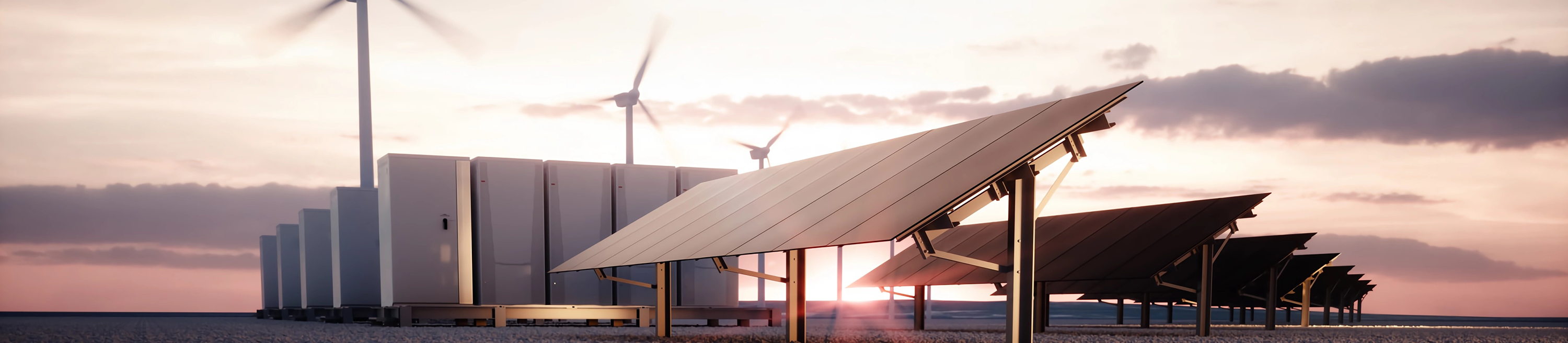
The most typical application of rack-mounted batteries is to couple with household photovoltaic systems to build a "photovoltaic storage integrated" solution. During the peak power generation of photovoltaic modules during the day, the battery stores excess electricity at a charging efficiency of 90%-95% (for example, a 10kWp photovoltaic system can produce 40-50kWh per day, with about 30% excess electricity). At night or in rainy weather, it releases electricity at a discharge efficiency of 85%-92%, increasing the household photovoltaic self-sufficiency rate from 40%-60% to 75%-85%. Taking Demuda's 100KWh rack-mounted battery as an example, when paired with a 20kWp photovoltaic system, it can meet 90% of the daily electricity demand of a 150㎡ household, reducing the annual power purchase from the power grid by about 12,000kWh, which is equivalent to reducing 6 tons of CO₂ emissions.
●Core tool for arbitrage of peak-valley electricity price difference
In areas where tiered electricity prices or peak-valley electricity prices are implemented, rack-mounted batteries optimize electricity costs through "low-valley charging - peak-peak discharging". Taking China's residential peak-valley electricity prices as an example, the electricity price during the low-valley period (0:00-8:00) is about 0.35 yuan/kWh, and during the peak period (14:00-17:00), it reaches 0.95 yuan/kWh. A 15kWh battery system can achieve a daily arbitrage of more than 10 yuan, and the static investment payback period is about 5-7 years. Demuda batteries support AC/DC bidirectional coupling, can be seamlessly connected to the power grid, and cooperate with the intelligent BMS system to automatically execute the peak-valley strategy, reducing household electricity costs by 30%-40%.
●Core guarantee of emergency backup power
In the face of frequent extreme weather (such as North American winter storms and Southeast Asian typhoons), rack-mounted batteries have become a "safe island" for household electricity. A typical 10kWh system can ensure that basic loads such as refrigerators, lighting, and routers can run for 12-24 hours, and systems above 20kWh can support high-power equipment such as air conditioners and water heaters. Demuda products have a wide operating temperature range of -10℃ to 50℃, and the IP20 protection level adapts to complex indoor environments. With a fast switching device (switching time <20ms), it can achieve "zero perception" power supply during power outages.
●Node hub for microgrid and EV charging
In the distributed microgrid scenario, rack-mounted batteries serve as energy buffer units to coordinate the dynamic balance between photovoltaics, energy storage, and loads, and support free switching between off-grid, grid-connected, and hybrid modes. At the same time, with the popularization of home EV charging piles, battery systems above 50kWh can be charged during the off-peak hours at night, and 3.3kW-22kW power can be used to power electric vehicles during the day to avoid the impact of centralized charging on the power grid.
2. Technological breakthroughs determine the competitiveness of rack-mounted batteries
●Energy density
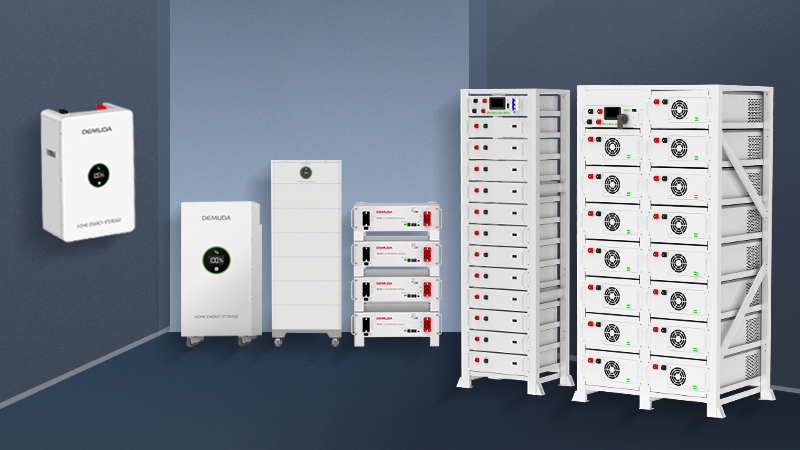
Energy density (Wh/L) determines the footprint of the battery system, which is particularly important for urban households. The energy density of mainstream rack-mounted lithium batteries is concentrated in 100-150Wh/L. For example, the Demuda 100KWh system has a volume of 1.8m³ (1100×1020×1600mm), and a unit volume energy density of 55.5kWh/m³. It supports 10 groups in parallel to expand to 1MWh, meeting the ultra-large capacity requirements of villas. Compared with traditional lead-acid batteries (50-80Wh/L), lithium batteries have a volume reduction of 40%-60% at the same capacity, making them the first choice for small households.
●Cycle life
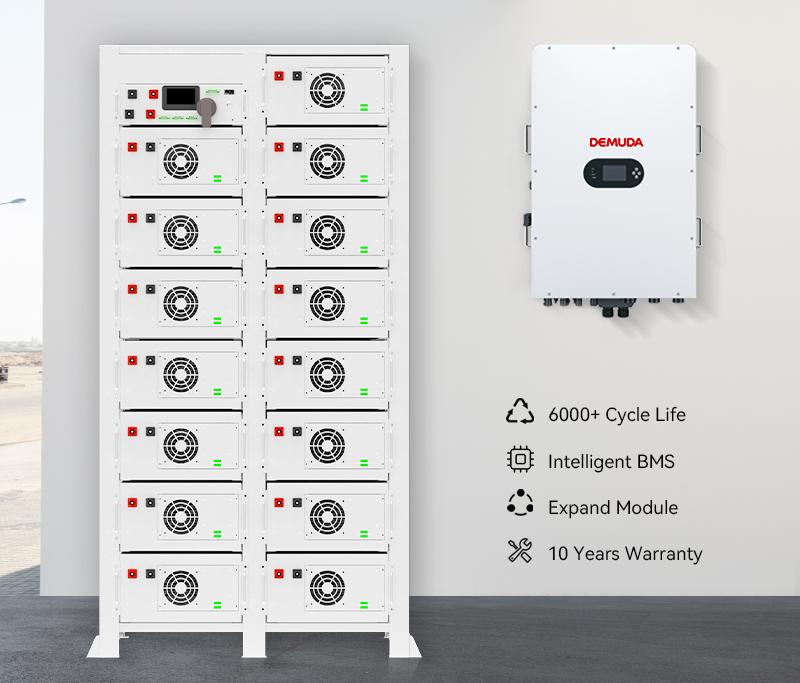
Cycle life (the number of charge and discharge times at 80% DOD) directly affects the battery replacement cycle. Lithium iron phosphate (LFP) rack-mounted batteries have become the mainstream of the market with a cycle life of 3,000-7,000 times, which is more than 3 times higher than ternary lithium batteries (500-2,000 times) and 10 times higher than lead-acid batteries (300-500 times). Based on 6,000 cycles, a 15kWh battery can be used for 13 years (once charged and discharged per day), and the full-cycle cost is as low as 0.6 yuan/kWh, which is significantly better than other technical routes.
●Charging and discharging power
Continuous discharge power (kW) determines the battery's ability to support high-power loads, and instantaneous peak power affects the start-up of motor loads. The Demuda 50kW model can support 5 10kW air conditioners to start at the same time, meeting the instantaneous power consumption requirements of multiple loads; its 3C continuous discharge capability (1C = 1 hour to fully charge/discharge), that is, a 100kWh battery can achieve 300kW instantaneous discharge, far exceeding the daily household power consumption peak (generally <50kW).
●BMS intelligence level
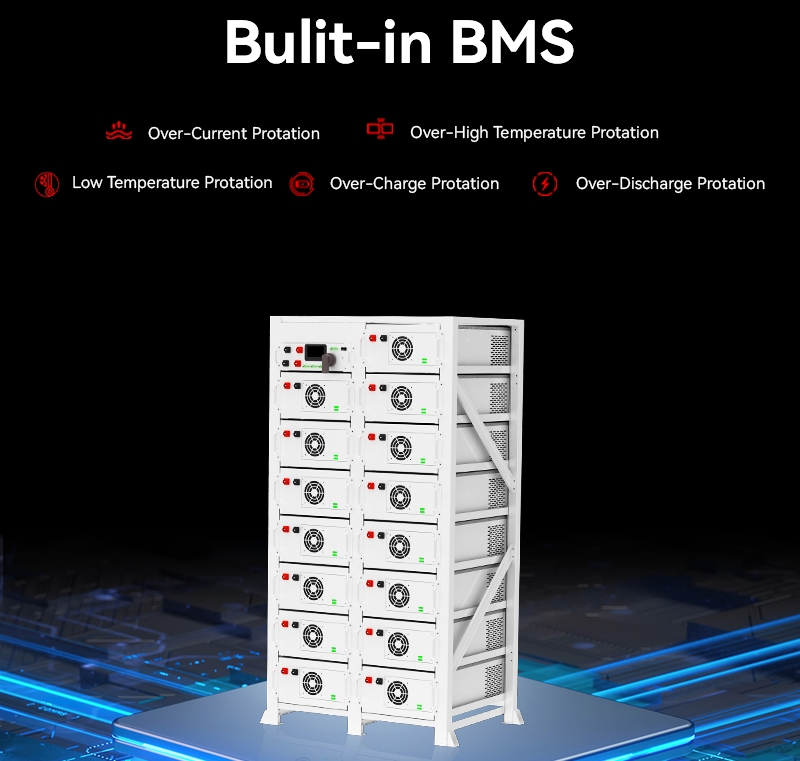
The battery management system (BMS) monitors the status of 240+ cells in real time through 16-bit ADC sampling accuracy, achieving a ±1% SOC (state of charge) estimation error, which is 50% more accurate than traditional BMS. Advanced thermal management systems (such as Demuda's air conditioning forced cooling) control the temperature difference of the cell to ±2℃, and with overcharge/overdischarge/overtemperature protection, the battery failure rate is reduced to 0.1 times/10,000 hours, meeting automotive-grade safety standards.
3. Global brand competition driven by technology
●International leading brands: technology accumulation and ecological integration
Tesla Powerwall is a benchmark for consumer energy storage. Powerwall 3 integrates 11.5kWh capacity and 7.6kW continuous power, supports linkage with Tesla photovoltaic and electric vehicle ecosystems, and realizes remote OTA upgrades through Wi-Fi. The global installed capacity exceeds 500,000 units. However, its unit price of US$25,000 (including installation) and energy density of 100kg/m³ make it less competitive in large-capacity scenarios.
Sonnen ecoLinx German brand Sonnen is known for its 98% system efficiency and 5,000 cycle life. It supports modular expansion to 100kWh, focuses on the high-end European market, and cooperates with energy companies such as E.on to launch an integrated "power storage-power sales" service.
●China's emerging forces: driven by cost-effectiveness and technological innovation
Demuda, as a representative of China's energy storage going overseas, focuses on large-capacity rack-mounted batteries. The 100KWh+50KW model has 10 parallel connection capabilities, supporting seamless expansion from home to small industrial and commercial scenarios. Its original "thermal resistance balancing technology" controls the battery attenuation rate to <3%/year, which is lower than the industry average of 5%. With RS485/Wi-Fi dual-mode communication, it realizes real-time monitoring of battery status and fault prediction. In the Southeast Asian and Middle Eastern markets, Demuda products have a 30% price advantage (compared to international brands) and customized voltage solutions (supporting 110V/220V dual standards), and the market share has rapidly increased to 15%.
4.Market and policy make rack-mounted batteries a potential in the future
●Market growth forecast
According to Bloomberg New Energy Finance (BNEF), the global household energy storage installed capacity will reach 12GWh in 2023, of which rack-mounted products account for 65%. It is expected that the market size will reach 120GWh in 2030, with a compound annual growth rate of 32%. The three major markets of China, Europe and the United States contribute 70% of demand. Emerging markets such as Southeast Asia and the Middle East have become the fastest growing regions (annual growth rate>40%) due to high electricity prices and rapid increase in photovoltaic penetration.
●Policy and business model innovation
Countries have accelerated penetration through subsidy policies: the US ITC subsidy covers 30% of energy storage investment, the German EEG subsidy reaches 0.15 euros/Wh, and China's household energy storage installed capacity target during the "14th Five-Year Plan" period is 10GWh.
Rack-mounted household energy storage batteries are transforming from "optional configuration" to "household energy rigid demand", and their technological progress and market popularity mark a fundamental change in energy consumption patterns. As capacity density continues to increase, costs continue to decline, and intelligence deepens, this product will not only be a power storage device, but also a core hub of the household energy ecosystem. For consumers, when choosing, they need to comprehensively consider the three core parameters of capacity matching, cycle life, and BMS function, and give priority to brands that have passed international certifications such as UL9540A and CE; for the industry, breaking through material bottlenecks, building a cross-domain ecosystem, and optimizing localized services will be the key to winning global competition. Driven by the dual carbon goals and energy security, the golden age of rack-mounted household energy storage batteries has already begun.